New Employee Orientation Guide, Tips and Setup
Published 08/11/2026

Welcoming new hires is both an exciting opportunity and a responsibility for any organisation. The first few days at a new job can set the tone for an employee's entire experience with your company.
A well-structured New Employee Orientation program not only helps newcomers assimilate into their roles but also fosters a sense of belonging from the start. By offering clear guidance, support, and resources, you empower employees to hit the ground running and contribute effectively right away. It's about more than just paperwork; it's about initiating a comfortable transition into your company's culture. It's a perfect strategy for ensuring the retention of those employees mostly needed by the organisation for their exceptional skills.
An orientation that's poorly conducted becomes the foundation of a negative experience for the employees, and they're left wondering why they availed themselves for the event. A new employee orientation may be part of your wider work orientation, onboarding system or employee induction. Watch our new employee orientation video.
View templates, forms and examples
See a ready-to-go new employee orientation you can adapt.
Why It Is Important to Create an Orientation Program for New Employees
An employee orientation gives new hires the chance to feel comfortable within their new department, role, and team in the workplace. Although many organisations take it as an administrative practice to familiarise new employees with the set rules or a platform to sign their contracts and immediately start their job, there is more than just all that.
Generally, new employee orientation is deemed to establish a relationship between the employer and the employee officially. The primary purpose of orientation is to make new workers feel welcomed, emotionally and mentally integrate them into the workplace, and help them successfully perform their tasks as soon as possible.
A complete employee orientation answers any concerns the new workforce may have about the organisation, its expectations, equipment, dress code, payment, and the various policies. Clear communication of the responsibilities and expectations of the organisation quickly boosts the productivity of the new employee.
A well-designed orientation program equips new employees with the necessary tools, support, and skills they need to reach their maximum productivity, and helps prepare them for their first day on the job. You might split the orientation up into stages as well, such as a pre-day 1 orientation activity through to week 1, month 1 and month 6 orientation, covering different training topics triggered at different milestones.
Discover our employee orientation platform
Deliver every stage online and track who has completed what.
What to Include in an Employee Orientation
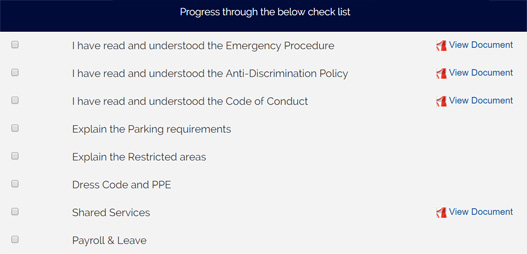
It's all about providing the right info for the right person, covering the company basics through to role-specific details. The orientation components will vary depending on the role, seniority and prior experience of the new hire. Employee orientation typically includes topics such as company background, workplace familiarisation, role clarity, safety protocols and key introductions.
A comprehensive employee orientation structure might include:
Company overview
An overview of the company's history, culture, mission, values and organisational structure.
Job roles and responsibilities
An explanation of the new hire's job role, responsibilities, reporting manager and team.
Employee handbook
Including detailed information on company policies, procedures, and codes of conduct.
Working schedule
A breakdown of regular working hours, break times, leave policy, and overtime policy if applicable.
Compensation and benefits
A breakdown of salary structure, pay schedule, health benefits, and superannuation.
Safety procedures
An explanation of the work environment, safety measures, emergency exits, muster points, first aid kits, and the company's policies on harassment and discrimination.
Tour of the organisation
A guided tour of the worksite to help new hires familiarise themselves with the various departments, restrooms, break areas and restricted areas.
Team introduction
A meeting with the new hire's team members and key personnel from other departments.
Overview of technology
Instructions on how to access and use company systems such as email, intranet, HRMS, or other essential software.
The First Impression: How Orientation Shapes Employee Experience

Effective staff onboarding does more than create a good first impression. Employees who go through structured orientation programs are more likely to stay long-term and report higher job satisfaction, which means lower turnover and higher productivity for the company. Introducing newcomers to their roles and responsibilities early also cuts down the time it takes them to become fully productive.
Orientation is more than paperwork and policy training. It builds camaraderie among colleagues, develops trust between staff and management, and helps new hires understand their roles more clearly. A smooth introduction to the workplace, its culture, and its expectations sets new employees up for long-term success.
For an organisation's staff orientation program to truly be effective, however, considerable effort must go into creating it. Activities shouldn't simply repeat standard induction information, but rather offer proper guidance about appropriate behaviour in the workplace, along with a focus on completing projects and assignments on time to meet department deadlines.
Strategies for Designing an Immersive and Impactful New Hire Experience

Create an engaging welcome and introduction
The new employee orientation is often the very first engagement point for a new staff member. This is where you could have a CEO welcome and meet the team for all new employees to make them feel appreciated. Introduce them to their new workplace and give the new hire an introduction to every department in the organisation, with lists of existing employees to meet who greatly contribute to the employee's success.
Use virtual reality (VR) tours
Virtual tours of the workplace or interactive webinars for specific departments provide engaging ways to introduce company culture and values without overwhelming the newcomer. These tools not only make learning more dynamic but also cater to varied learning styles. Some people absorb information better visually while others prefer hands-on experiences. By incorporating diverse methods of engagement, you're likely to capture everyone's attention.
Use AI videos to enhance your content
Try our AI video generator to create really engaging content just off a text prompt! By turning text into video, you can create a more interactive, visually impressive, and memorable orientation that helps new hires feel connected and prepared from day one. Describe the video you want and generate a dynamic video from your text prompt. Discover our AI video creator.
Setting New Hires up for Success with the Right Tools and Information from Day One

The process of capturing new employee information can sometimes feel like a daunting task. It's not just about collecting forms and signatures; it's about setting the stage for being compliant, efficient and building successful working relationships with the employee. It's essential to inform new employees of company rules, policies, and required forms to be completed during orientation.
It's equally important that the documents are accessible to the relevant management in a secured HRIS or LMS to confirm they have been read and completed by new employees. By integrating efficient systems for gathering necessary data such as contact details, emergency contacts, and certifications, you help create a streamlined transition that benefits everyone involved.
The new employee orientation program should also proactively manage all logistical setups to prevent any first-day friction, including:
Office and building access
To minimise any hardships for the employee on their first day, the orientation program should cover access cards, office maps and locations, restrooms, and designated parking areas. It's best to eliminate any unnecessary obstacles like not being able to park or enter the building. This experience can make a new employee feel unwelcome and undervalued, turning what should be an exciting milestone into a stressful start.
Software and hardware
To be productive members of the organisation, employees need access to tools for time tracking, project management and virtual communication. They also need to be equally guided on how to use tools such as phones and printers.
Virtual vs. On-Site Orientation: What's the Right Choice for Your Company?
Some organisations choose to offer online and self-guided training for new employees to gain a general overview of the organisation before the face-to-face interaction. Online orientations enable new employees to learn the processes in their own time and pace. In most cases it simplifies the orientation process.
Online orientation
- Improved cost and time efficiency.
- Scalability and consistency in training large numbers of employees at once.
- Enhanced tracking and analysis of employees' orientation progress and engagement.
- Streamlined administration by using centralised storage of the required forms and documents.
- Minimised operational impact by freeing up experienced employees and leadership from time-consuming in-person orientation, allowing them to focus on their core responsibilities.
Face-to-face orientation
An online orientation doesn't necessarily have to replace face-to-face interaction. Traditional face-to-face orientations have their own unique benefits that shouldn't be overlooked. They create an opportunity for genuine engagement that might be harder to achieve through a screen.
However, they often require significant planning and resources, including travel arrangements and meeting spaces, factors that can quickly become costly.
Ultimately, deciding on the best approach involves weighing these advantages against each other to see what aligns best with your company's needs and goals. Some organisations find success in blending both methods: offering preliminary online modules followed by in-person sessions for more interactive components. Whatever path you choose, the key is ensuring that your orientation process effectively integrates new employees into your company culture while equipping them with the knowledge they need to succeed in their roles.
View a sample new employee orientation
See how welcome videos, policies, quizzes and sign-offs come together in one online orientation your new starters can complete before day one.
View the sample orientation