Contractor Prequalification Is Your Contractor Really Qualified? A Complete Guide to Contractor Prequalification
Bring contractor documents, verification, approval and worker induction into a clear process, with records that support each decision.
You've been invited
A contractor receives an invitation to complete the prequalification form on their tablet.
Illustrative animation. No invitation is sent and no real contractor data is submitted.
Collect the right information
The contractor submits the company details and documents required for its work and risk category.
Sample workflow only. Approval decisions and site access depend on your configured requirements and review process.
Explore this guide
- What Is Prequalification of Contractors and Why Does It Matter?
- How to Prequalify a Contractor Step-by-Step
- Best Practice Guide to Contractor Prequalification
- Using a System to Support Contractor Prequalification
- The Risks of Poor Record-Keeping in Contractor Prequalification
- AI Licence Verification and Using an Online Induction System
- Build a Contractor Prequalification Program That Works
What Is Prequalification of Contractors and Why Does It Matter?
Defining Contractor Prequalification
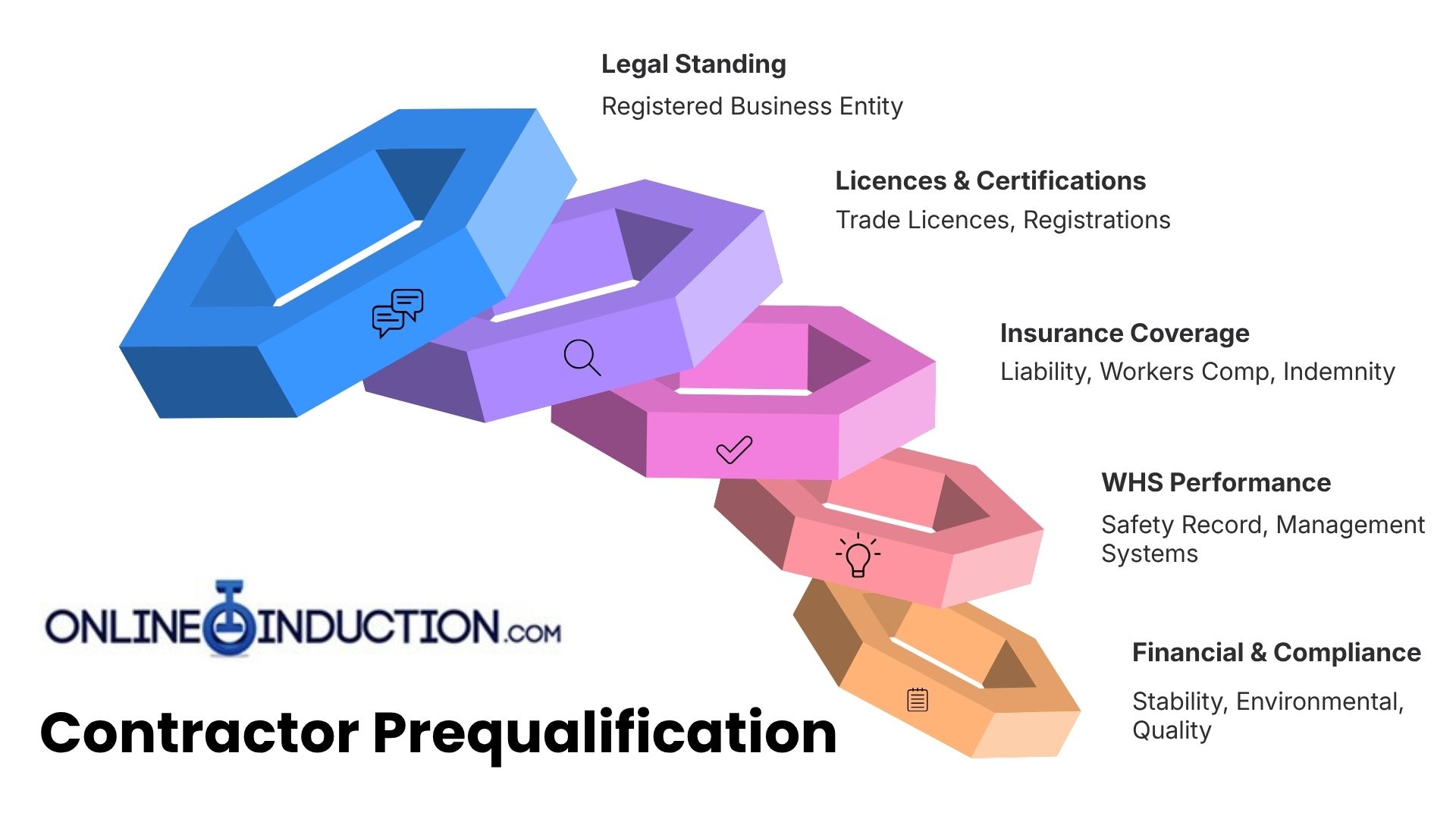
Contractor prequalification is the formal process of assessing, verifying, and approving contractors before they are permitted to perform work on behalf of your organisation. It goes beyond checking a reference or requesting a resume. A robust prequalification process evaluates a contractor's:
- Legal standing — Are they a legitimately registered business entity?
- Licences and certifications — Do they hold the correct trade licences, industry certifications, and professional registrations for the work being performed?
- Insurance coverage — Do they carry adequate public liability, workers' compensation, and professional indemnity insurance?
- Work Health and Safety (WHS) performance — What is their safety record? Do they have a documented safety management system?
- Financial stability — Are they financially capable of completing the contracted work?
- Environmental and quality compliance — Do they meet the environmental and quality standards your organisation or regulators require?
Why Prequalification Is Non-Negotiable
The stakes of skipping or rushing prequalification are significant. Across industries, engaging an unqualified, uninsured, or unsafe contractor can result in:
- Workplace injuries or fatalities that trigger regulatory investigations and prosecution
- Financial liability for damage, defects, or incomplete work
- Regulatory penalties for engaging unlicensed tradespeople
- Reputational damage that affects your ability to win future contracts
- Project delays caused by contractor non-performance or removal from site
In Australia, Work Health and Safety legislation places a positive duty on principal contractors and persons conducting a business or undertaking (PCBUs) to ensure the safety of workers — including contractors. Prequalification is a critical part of discharging that duty.
Beyond compliance, prequalification is also simply good business. Organisations that know who they are working with complete projects faster, more safely, and with less rework.
How to Prequalify a Contractor Step-by-Step
Step 1: Define Your Prequalification Categories
Not every contractor carries the same risk profile. A landscaper and an electrical contractor working at height in a live environment require very different levels of scrutiny. Begin by segmenting your contractors into risk tiers — typically low, medium, and high — based on factors such as:
- Type of work (routine maintenance vs. specialist high-risk work)
- Duration and frequency of engagement
- Number of workers involved
- Proximity to hazardous environments, plant, or equipment
Your prequalification requirements should scale with risk. This keeps the process proportionate and avoids creating unnecessary friction for low-risk suppliers while ensuring rigour where it counts.
Step 2: Develop a Prequalification Questionnaire

A structured prequalification questionnaire is the foundation of your assessment. It should capture:
Company Information
- Legal name, ABN/ACN, business structure
- Years in operation, key personnel
- Geographic coverage
Licences and Certifications
- Contractor licence numbers and issuing authority
- Relevant trade or occupational licences
- Industry-specific certifications (e.g., AS/NZS standards compliance)
- Expiry dates for all credentials
Insurance Documentation
- Certificate of currency for public liability (minimum coverage amounts vary by industry and risk)
- Workers' compensation policy details
- Professional indemnity (where applicable)
Safety Management
- WHS policy and management system documentation
- LTIFR (Lost Time Injury Frequency Rate) and TRIFR data for the past three years
- Evidence of safety training, toolbox talks, and incident investigation processes
- Details of any prosecutions, enforceable undertakings, or improvement notices
References and Past Performance
- Client references for comparable work
- Examples of relevant completed projects
Step 3: Document Review and Verification
Receiving documents is not the same as verifying them. This is the step most organisations do poorly. Document review should include:
- Checking licence numbers against the relevant state or national licensing register
- Confirming insurance certificates are current, correctly named, and meet your minimum coverage requirements
- Reviewing WHS statistics for trends or red flags
- Following up with references provided
Manual verification is time-consuming and prone to human error — which is why automated verification tools are increasingly valuable. Online Induction's AI licence verification feature handles this automatically, in real time.
Step 4: Conduct a Pre-Engagement Assessment
For medium and high-risk contractors, consider supplementing the document review with a direct assessment — either a site visit to observe how the contractor manages their own workplaces, or a structured interview with key personnel to test their understanding of safety obligations and your site requirements.
Step 5: Make a Prequalification Decision
Based on your review, contractors should be categorised as:
- Approved — meets all requirements; cleared to proceed to onboarding
- Conditionally Approved — minor gaps identified; approved subject to resolution within a defined timeframe
- Not Approved — material gaps in compliance, safety performance, or documentation; not cleared to work
Communicate decisions clearly and in writing. Where contractors are not approved, provide specific reasons so they have the opportunity to remedy issues and reapply.
Step 6: Set Expiry and Renewal Dates
Prequalification is not a one-time event. It must be kept current. Establish review cycles — typically annually for most contractors, or more frequently for high-risk engagements — and set automated reminders so both your team and the contractor receive advance notice before credentials expire.
Best Practice Guide to Contractor Prequalification

Principle 1: Make It Systematic, Not Ad Hoc
Best practice prequalification is a documented, repeatable process — not something left to the discretion of individual project managers or procurement officers. Develop a formal Contractor Management Procedure that defines roles, responsibilities, minimum requirements, decision criteria, and record-keeping obligations. Ensure all relevant staff are trained on it.
Principle 2: Standardise Your Requirements — But Remain Flexible
Establish baseline requirements that apply to all contractors, then layer additional requirements based on risk category. Avoid the temptation to create bespoke requirements for every engagement — this creates inconsistency, confusion, and administrative burden.
Principle 3: Engage Contractors as Partners
Prequalification works best when contractors understand what you are asking for and why. Publish your requirements clearly. Provide guidance documentation that explains what documents you need and in what format. Make the submission process straightforward. The easier you make it to submit a complete and compliant package, the better quality information you will receive.
Principle 4: Verify, Don't Just Collect
Collecting documents and verifying them are two different things. A certificate of currency that expired three months ago, or a licence that has been suspended, is worthless if nobody checks. Build verification into your process as a non-negotiable step — and consider automated tools that do this in real time.
Principle 5: Keep Records That Tell a Story
Your prequalification records are not just administrative paperwork — they are evidence of your due diligence. In the event of a workplace incident, a regulatory audit, or a legal dispute, you need to be able to demonstrate that you verified credentials, assessed risk, and made informed decisions. Records should be complete, timestamped, easily retrievable, and retained in line with your legal obligations.
Principle 6: Build in Continuous Monitoring
Prequalification covers the period up to engagement. But circumstances change — licences lapse, insurance policies expire, safety performance deteriorates. A best practice program includes ongoing monitoring of approved contractors, with automated alerts when credentials are approaching expiry or when concerns arise.
Principle 7: Link Prequalification to Induction
Prequalification approves the contractor company. Site or task induction approves the individual worker. These two processes should be linked — a worker should not be cleared for site access until both the company is prequalified and the individual has completed the required induction. Online Induction makes this integration seamless, connecting prequalification status directly to induction completion and site access.
Using a System to Support Contractor Prequalification
Why Spreadsheets and Shared Drives Are Not Enough
Many organisations still manage contractor prequalification through a combination of email, shared drives, and spreadsheets. While this may seem manageable with a small contractor base, it quickly breaks down as the number of contractors, documents, and renewal dates grows. Common problems include:
- Documents stored in inconsistent locations with no central visibility
- No automated alerts for upcoming expiries
- Difficulty demonstrating compliance during audits
- Version control issues — who has the latest certificate?
- No audit trail of who verified what and when
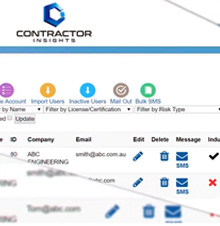
A dedicated contractor management system solves these problems by providing a single source of truth for all contractor data, documents, and verification status.
What to Look for in a Contractor Management System
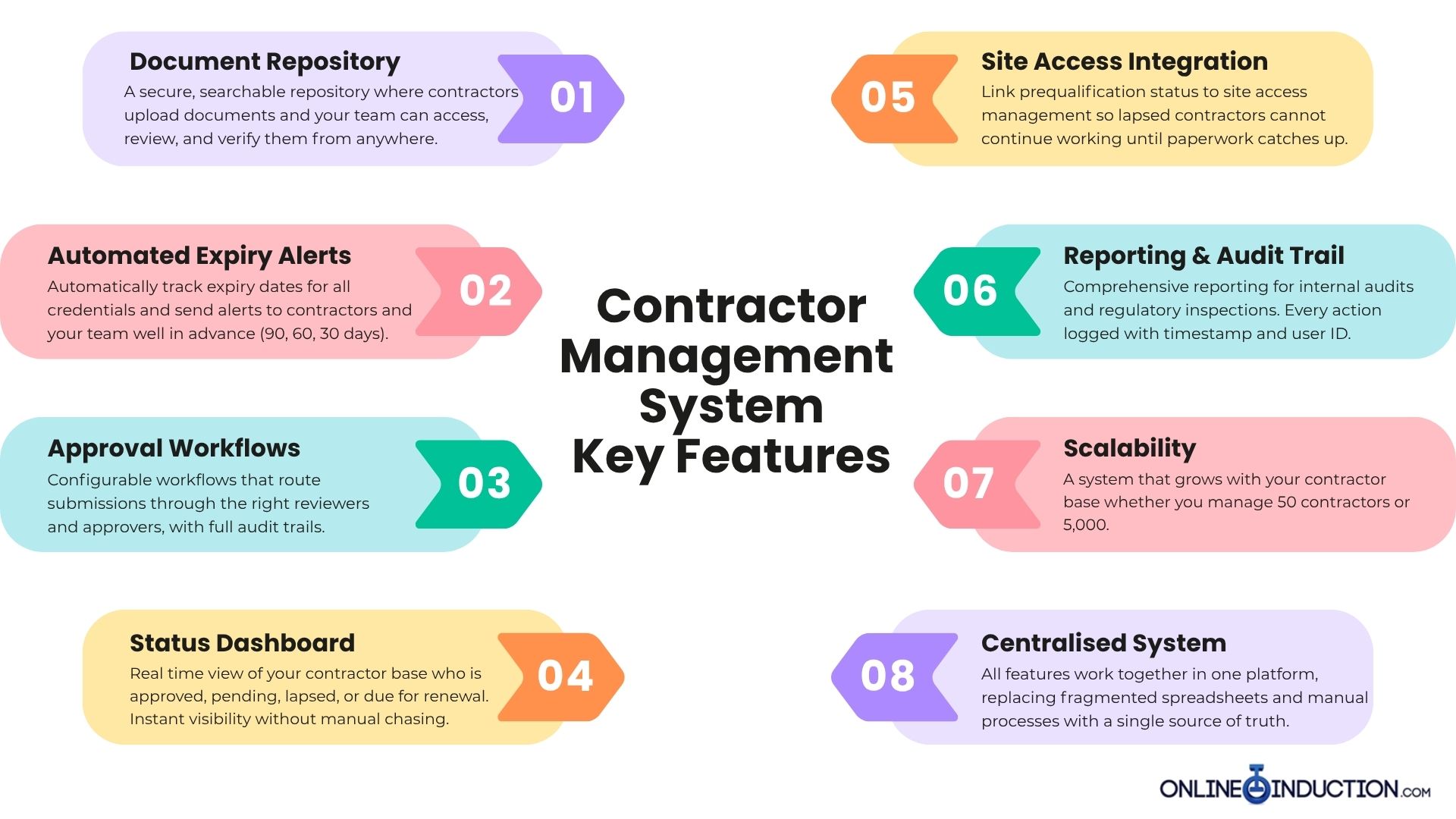
When evaluating systems, key features to prioritise include:
Centralised Document Repository
A secure, searchable repository where contractors upload their documents — and where your team can access, review, and verify them from anywhere.
Automated Expiry Alerts
The system should automatically track expiry dates for all credentials and send alerts to both contractors and your internal team well in advance. Configurable lead times (e.g., 90, 60, 30 days before expiry) allow you to build in sufficient time for renewal.
Approval Workflows
Configurable workflows that route submissions through the right reviewers and approvers, with audit trails that capture every action taken and by whom.
Prequalification Status Dashboard
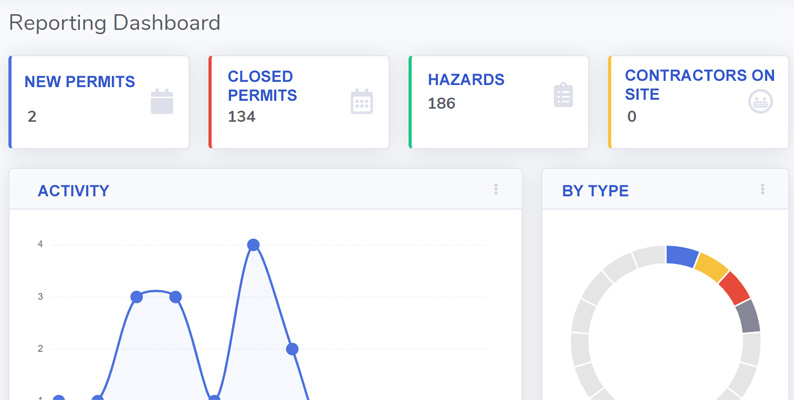
A real-time view of your entire contractor base — who is approved, who has pending items, whose status has lapsed, and who is due for renewal. This gives procurement and WHS teams instant visibility without manual chasing.
Integration with Site Access Controls
The ability to link prequalification status to site access management — so a contractor whose status has lapsed cannot simply continue working until the paperwork catches up.
Reporting and Audit Trail
Comprehensive reporting that supports internal audits, regulatory inspections, and management reporting. Every document submission, verification action, and status change should be logged with a timestamp and user ID.
Scalability
A system that can grow with your contractor base — whether you manage 50 contractors or 5,000.
Benefits of a Systemised Approach
Organisations that move from manual processes to a dedicated contractor management system consistently report:
- Significant reduction in administrative time spent chasing documents
- Fewer compliance gaps due to lapsed credentials going unnoticed
- Faster contractor onboarding due to streamlined submission and review
- Greater confidence in the completeness and accuracy of their contractor data
- Stronger audit outcomes due to clear, retrievable records
The Risks of Poor Record-Keeping in Contractor Prequalification
What Happens When Records Are Incomplete or Inaccurate?
Poor record-keeping in contractor prequalification is not just an administrative inconvenience — it creates serious legal, financial, safety, and reputational exposure. Here is what the consequences can look like in practice.
Legal and Regulatory Consequences
Under WHS legislation in Australia, a PCBU that fails to exercise due diligence in managing contractors can face significant penalties. Regulators — including SafeWork NSW, WorkSafe Victoria, and their counterparts in other states — will examine contractor management records closely following a workplace incident. If those records are incomplete, inconsistent, or simply non-existent, the organisation faces a much harder task demonstrating it met its duty of care.
In some cases, incomplete prequalification records have contributed to findings of reckless conduct — attracting penalties of hundreds of thousands of dollars for organisations, and personal liability for directors and officers.
Beyond WHS, engaging an unlicensed contractor exposes the principal organisation to liability under the relevant licensing legislation in each state and territory.
Financial Consequences
Engaging a contractor who is inadequately insured — or whose insurance has lapsed — can leave your organisation directly exposed to claims for property damage, third-party injury, or professional negligence. If the contractor does not have the means to satisfy the claim, the liability may fall to you.
Poor record-keeping also creates procurement risk. Without a clear, auditable record of which contractors are approved and on what basis, organisations are vulnerable to:
- Paying contractors for work they were not qualified to perform
- Renewing contracts with underperforming contractors due to lack of performance data
- Approving contractors without completing required checks, then facing liability when problems arise
Safety Consequences
An unlicensed electrician. An asbestos removalist without current certification. A crane operator whose licence was revoked two years ago. These are not hypothetical risks — they are the real-world consequences of prequalification processes that rely on document collection without verification.
When critical credentials go unverified, the people most directly exposed to harm are the workers on your sites. Poor prequalification record-keeping creates the conditions for serious injuries and fatalities.
Reputational Consequences
In industries where contractor performance is visible — construction, infrastructure, facilities management, mining — your reputation as a principal contractor or client is shaped by the behaviour of the contractors you engage. An incident involving an unqualified or unsafe contractor reflects on your organisation, even if you did not directly employ the individual involved.
The Five Most Common Record-Keeping Failures
- No centralised system — documents stored across email, shared drives, and individual desktops with no master register
- No expiry tracking — credentials allowed to lapse because no one was monitoring renewal dates
- Verification not documented — documents received and filed without any record of whether they were verified against source registers
- Inconsistent requirements — different projects or procurement officers applying different standards, making it impossible to demonstrate a consistent approach
- Poor retention practices — records deleted or lost, making it impossible to reconstruct the prequalification history for a contractor in the event of an incident or audit
AI Licence Verification and Using an Online Induction System
The Technology Gap in Traditional Prequalification
Even organisations with well-designed prequalification processes often face a fundamental constraint: the verification step is manual, slow, and prone to error. A document that looks legitimate may be expired, fraudulent, or simply not applicable to the work being performed. A human reviewer working through a stack of submissions cannot realistically check every credential against every licensing register in real time.
This is where AI-powered verification and integrated Online Induction are transforming contractor management.
AI Licence Verification: What It Is and How It Works
AI licence verification uses machine learning and automated data matching to verify contractor licences and credentials against authoritative source registers — without requiring a human reviewer to manually search each register.
Here is how the process works within Online Induction:
- The contractor uploads their licence or credential — either as a photo, scan, or digital document.
- The AI extracts key data — including the licence number, licence type, issuing authority, holder name, and expiry date — using optical character recognition (OCR) and document intelligence.
- The system automatically queries the relevant register — for example, the NSW Fair Trading licence register, the Australian Health Practitioner Regulation Agency (AHPRA) register, or the relevant state electrical safety authority — to confirm that the licence is current, correctly categorised, and issued to the right person.
- The result is returned instantly — with a verified or unverified status, a timestamp, and a record of the source checked.
- Any discrepancies are flagged — for example, if the name on the licence does not match the contractor record, if the licence class does not match the work being performed, or if the licence has been suspended or cancelled.
This entire process — which might take a human reviewer 10–15 minutes per licence if done manually — takes seconds. And unlike manual verification, it is consistent, documented, and cannot be skipped.
The Benefits of AI Licence Verification
Speed: Contractors can be verified in near real time, reducing onboarding delays significantly.
Accuracy: Eliminates human error in reading documents or mistyping licence numbers into search fields.
Consistency: Every credential is verified the same way, every time, regardless of who submitted it or who is processing it.
Auditability: Every verification is timestamped and recorded, creating a clear audit trail that demonstrates due diligence.
Fraud detection: AI can identify anomalies in document formatting, inconsistencies in data fields, or credentials that do not match known issuance patterns — catching fraudulent or altered documents that might pass a quick visual review.
Continuous monitoring: Online Induction periodically re-checks credentials in the background — so if a licence is suspended mid-engagement, your system knows immediately.
Online Induction: The Bridge Between Prequalification and Safe Work
Prequalification confirms that a contractor company is qualified and compliant. But before any individual worker sets foot on site, they also need to understand your specific site, its hazards, your safety rules, and the emergency procedures that apply to their work.
This is the role of site induction — and Online Induction has transformed how this is delivered.
What Online Inductions Cover
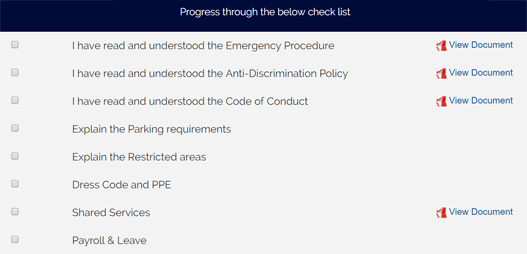
- Site-specific hazard identification and risk controls
- Emergency procedures, evacuation routes, and muster points
- Site rules and access procedures
- Personal protective equipment requirements
- Incident and near-miss reporting procedures
- Environmental management requirements
- Introduction to key contacts and management structure
How Online Induction Works
Online Induction allows workers to complete their site induction before they arrive — on any device, in any location, at any time. Key features include:
- Multimedia content delivery — video, interactive modules, and knowledge checks rather than static PDFs
- Multilingual support — inductions delivered in the worker's preferred language, improving comprehension and retention
- Comprehension testing — workers must demonstrate understanding before they can pass the induction
- Digital records — completion is automatically recorded with a timestamp, the worker's identity, and the specific induction content completed
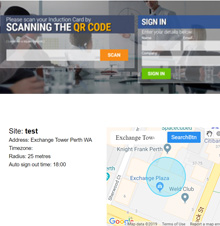
- Integration with site access — induction status can be linked to QR code or card-based site access systems, so a worker who has not completed their induction cannot gain entry
The Add-On Feature: AI-Powered Identity Verification in Online Induction
Online Induction's AI identity verification add-on closes a significant gap in traditional induction processes — where there is nothing to stop one worker completing an induction on behalf of another.
The feature works by:
- Capturing a photo or short video of the worker during the induction process
- Comparing this against a verified ID document — such as a driver's licence or passport — that the worker has already provided
- Using facial recognition and liveness detection to confirm the match and prevent the use of static photos
Combined with AI licence verification, this creates an end-to-end verified record: the contractor company is qualified, the individual worker's licence is current, and the person who completed the induction is confirmed to be the same person presenting at site.
The Integrated Workflow: From Prequalification to Site Access
Online Induction brings AI licence verification and online induction together in a single platform, creating a seamless end-to-end workflow:
- Contractor company submits prequalification — documents are auto-verified by AI against source registers
- Company is approved — status recorded in the system with full audit trail
- Individual workers are registered — licences and credentials verified by AI at the individual level
- Workers complete their Online Induction — with AI identity verification confirming they are who they say they are
- Site access is granted — automatically or with a single approval step, with real-time status visible to site supervisors
- Ongoing monitoring — the system continues to check credential validity and alerts relevant parties when renewal is required
Organisations across construction, resources, utilities, and facilities management are using this workflow today — and the results speak for themselves: fewer compliance gaps, faster contractor mobilisation, and a demonstrably stronger safety culture.
Build a Contractor Prequalification Program That Works
Contractor prequalification is one of the most important risk management activities your organisation undertakes. When done well, it protects your people, your finances, and your reputation. When done poorly — or not at all — the consequences can be severe and lasting.
The good news is that the tools available today make best practice prequalification more accessible than ever. Automated workflows, AI licence verification, and integrated Online Induction remove the manual burden from your team while raising the standard of verification and record-keeping.
If your organisation is still managing contractor prequalification through email and spreadsheets, now is the time to change that. The risk of doing nothing has never been higher — and neither has the opportunity to get it right.
Explore templates →